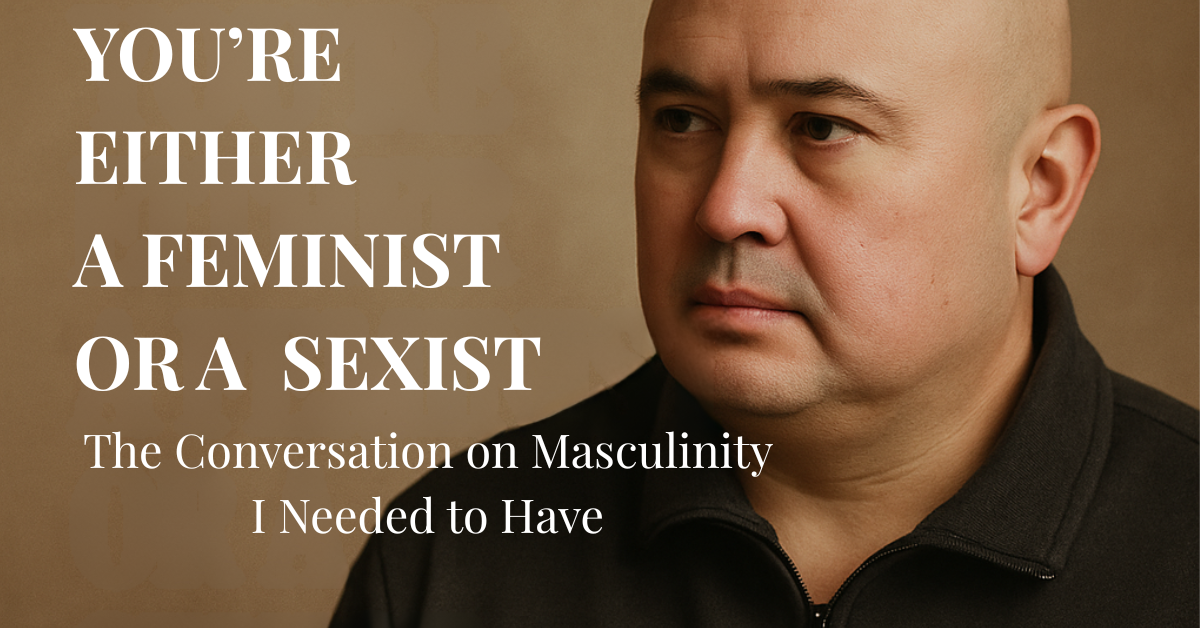
If 'you're either a feminist or a sexist' makes you defensive, that's okay. Sit with it. I had to.
I'm trying to live by my philosophy that safe people create brave spaces, and that in order to create brave spaces, we need to be brave in our conversations. Creating a brave space means putting yourself into a place of vulnerability, a space where you might be wrong. Or, as my six-year-old reminds me, every loss is a lesson.
What toxic masculinity actually is
Toxic masculinity is a set of social expectations that define manhood through dominance, control, and emotional repression. It tells men that to be strong they must never show vulnerability, that power is proven through aggression or status, and that anything resembling softness or care is weakness.
This mindset harms everyone. It isolates men from their emotions, damages relationships, and reinforces systems that value authority over empathy. At its core, toxic masculinity isn't about men being bad; it's about unhealthy behaviours and beliefs that limit men's full humanity and deny the value of balance, compassion, and equality.
I've witnessed toxic masculinity in football clubs, pubs, social settings, boardrooms, and every space I've ever worked in. I've heard many toxic masculinity conversations start or end with, 'It's only a joke,' or, 'I do this to make myself laugh.'
In my lifetime, the worst type of toxic masculinity is the one that silences good men from calling out bad behaviour. Behaviour that I've seen harm children, not just through violence, but through silence. The inability to speak up because doing so would be seen as weakness, or 'dogging the boys,' which is possibly the most toxic and disgusting excuse of all.
The challenge of brave conversations
The challenge I've had recently comes from my core standard that I don't want to punch down. I want to uplift. But this becomes difficult when discussing toxic masculinity with men. I face the challenge of not wanting to put them down for their behaviour but still needing to call it out.
We are not bad men. Most of us are good men trying to do our best inside systems that taught us not to feel, not to listen, and not to challenge one another. But that's the problem. Being a 'good man' isn't enough if we stay silent in the face of harm. Masculinity that refuses to evolve becomes a shield for inaction.
Real strength isn't found in being right, loud, or dominant. It's found in being accountable, curious, and willing to unlearn what no longer serves us or those around us.
Bravery as growth
What I'm learning is that bravery isn't about fighting. It's about staying in the discomfort long enough to grow. It's about being able to say, 'I got that wrong,' or, 'I see now how that made you feel.' That's where safe people come from.
The statement 'you're either a feminist or a sexist' helped me realise that feminism isn't about taking something from men. It's about giving us permission to be whole again. It invites us to value empathy, equality, and care as much as confidence, ambition, and drive. It asks us to stop defining strength by how well we can dominate, and start defining it by how well we can make room for others.
Brave spaces start with safe people, and safe people are the ones brave enough to ask: What part of me still believes that caring makes me weak?
That's what the philosophy 'you're either a feminist or a sexist' has done for me. It's not a weapon. It's a mirror. And it's helped me see that the work ahead isn't about fighting feminism. It's about freeing masculinity.