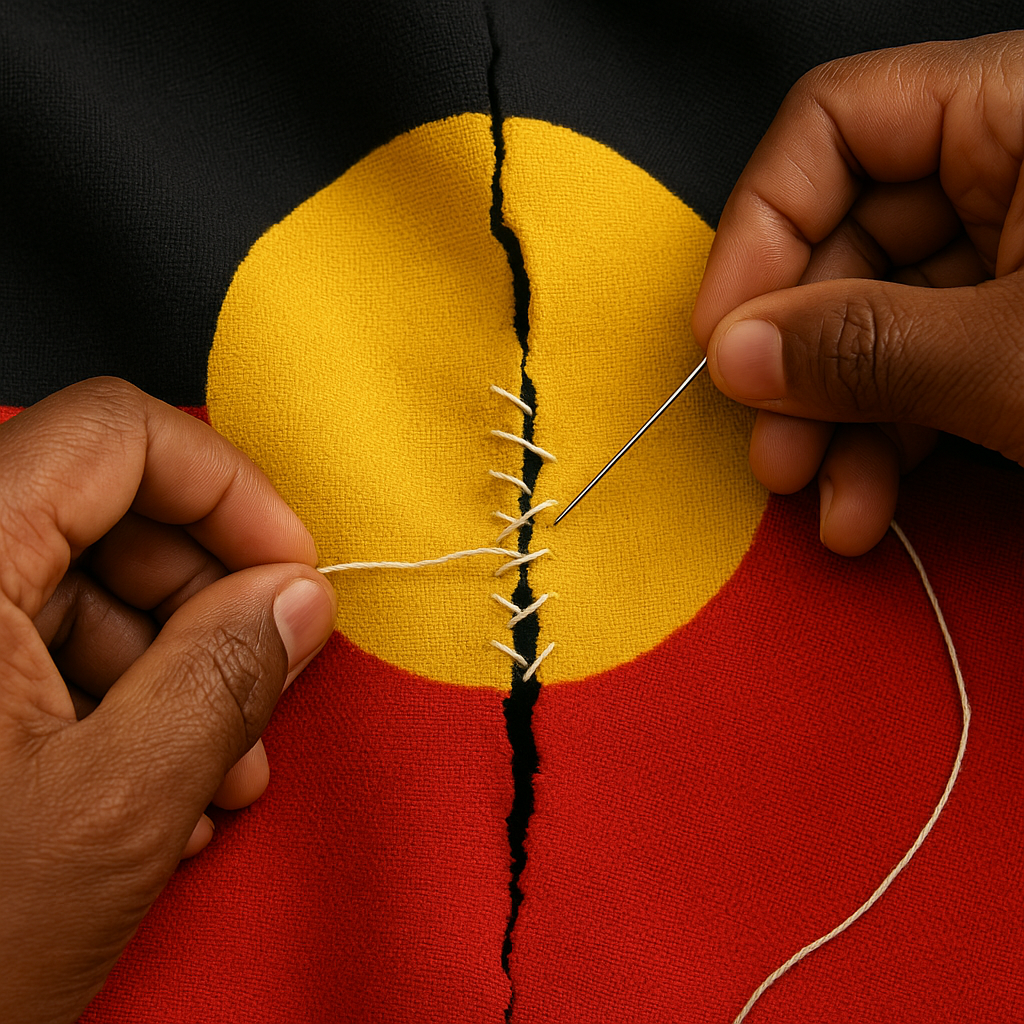
Since the 2008 Apology, to 2019, I was filled with hope. The world was changing. Inclusion and unity were real things. Australia felt like it was finally walking towards something bigger than symbolism, something that carried substance. We were not there yet, but the trajectory was upwards.
Now, that feeling has gone.
The Aboriginal Flag, once our most powerful unifying symbol, became the site of a legal and cultural battle that fractured this country. And the consequences are far deeper than a copyright dispute. They touch on trust, leadership, and the mental health of an entire people.
From unity to fracture
The Aboriginal Flag was created in 1971 and declared an official 'Flag of Australia' in 1995. For decades, it was our rallying point, raised on the Tent Embassy, painted on faces at protests, flown proudly in schools, stitched onto AFL guernseys, and draped over stages where truth was spoken. It was more than cloth. It was identity. I felt taller when I had it on.
But in 2019, everything changed. Cease-and-desist letters began landing on the desks of Aboriginal-owned businesses, charities, and sporting codes. The message was blunt: you cannot use the flag on clothing without paying a private, non-Indigenous company.
The AFL was forced to run its Indigenous Round without the flag for the first time in over a decade. Aboriginal organisations were told to pull merchandise or pay fees. Even charities raising money for health programs were threatened.
A flag that symbolised our collective strength was turned into a commodity.
The ripple effect: mistrust and doubt
This was not just a copyright issue. It became a trust issue.
For non-Indigenous Australians, watching this play out looked like dysfunction. How could something so sacred to Aboriginal identity end up in private hands? How could our most important cultural symbol be so contested?
The result was a perception, unfair but powerful, that Aboriginal people cannot manage their own affairs. That perception, magnified by media coverage and community division, sat quietly in the national psyche.
By the time the Voice referendum came around, that seed of mistrust had already been watered. The question of Aboriginal leadership and unity was already framed by years of headlines about 'flag fights' and legal battles.
It is my belief that this fractured moment was one of the dominoes that tipped towards the No vote.
The human cost: mental health in crisis
But the deepest cost was not political. It was human.
For Aboriginal people, the flag is not just a design. It is blood, land, and identity. When it was taken from us, turned into a product we had to pay to use, it hit like another dispossession. A dispossession that is now impacting us greater than we could have imagined.
I saw Elders furious and heartbroken. I saw young people who had painted that flag on their faces for school NAIDOC Week suddenly told it was 'owned.' I saw Aboriginal businesses forced to redesign shirts, uniforms, and campaigns, losing both income and pride.
All of this landed in a community already carrying layers of intergenerational trauma. And in my lifetime, I can say clearly: our mental health has never been under such strain.
Why this matters for leadership
Leaders in business, government, and community often ask me: why does symbolism matter? Isn't this just about a flag?
My answer: it is never just about the flag. It is about what the flag represents. When systems mishandle something sacred, the effects cascade across operations, social trust, and the psychological wellbeing of First Peoples.
A way forward
We cannot undo the fracture. But we can learn from it.
First, we must acknowledge the damage. Pretending the flag saga was a 'technical copyright issue' is to deny its human impact.
Second, we must rebuild trust. That means investing in Aboriginal leadership and self-determination, not just symbolic gestures.
Third, we must address the mental health toll openly. Aboriginal people are not just 'resilient.' We are tired. And without brave spaces and genuine support, the suffering will deepen.
Finally, we need to reclaim the flag as a symbol of unity, not division. It must be free in spirit, flying in stadiums, schools, and parliaments as a mark of respect, not a reminder of fracture.
We need all Australians to recognise that right now, Aboriginal people are suffering. Right now we need our allies to stand up. Reach out to Aboriginal staff, speak with them, check in with them. And please don't let racism win.